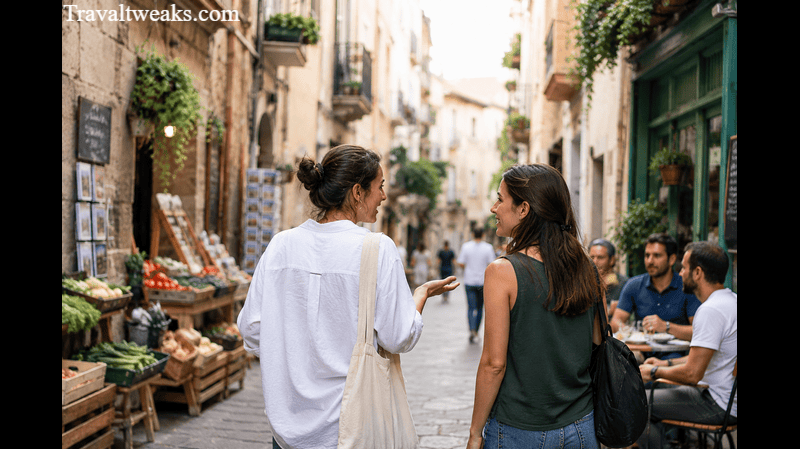
When I first started my travel journey, I was very much dependent on guidebooks. It was one of the mistakes I made earlier. So one day, I made a decision to do a trip without using any guidebook. I chose Istanbul for my final destination. And trust me it was one of the best trips I had planned.
I reached there early in the morning and I had already booked an Airbnb in the local area. Did the check-in and took some rest. After that I picked up my bag, without any guides I went straight down the streets. Traveltweaks travel explains how you should do this all.
These Steps Will Help You Enjoy Your Trip Like a Local:
- Stay in a Neighborhood Not a Hotel District
- Eat Where There Are No Menus in English
- Use Public Transport Like You Live There
- Shop at Local Markets Not Tourist Souvenir Shops
Stay in a Neighborhood Not a Hotel District
The problem with hotels are :
- Many hotels cluster around the same tourist spots
- Surrounded by places designed for visitors not living
- Higher prices compared to local prices
- No neighborhood only surrounded by visitors
- Less interaction with locals
- Higher prices for food
If you stay in a neighborhood it will have:
- Unique local spots to discover
- Places where actual local lives
- Prices for staying are very low compared to hotels
- Surrounded by visitors, more experience of local culture
- More interaction with locals
- Low prices of food with local taste
Well staying at hotels gives a good experience but if you are going for a local experience then Traveltweaks suggests you to go for the local areas.
For Istanbul, we recommend Karakoy or Cihangir rather than Sultanahmet because it is not surrounded by tourists but with the local environment.
Eat Where There Are No Menus in English
If you travel to another country whose native language is not English, then their menus must be in their own language. Right? But when you travel to a tourist focused spot then all the cafes have menus in English, what does that mean? These are the red flags that the restaurant is only made to capture tourists and not for good food.
Must avoid these red flags:
- There will always be someone outside the restaurant trying to capture you into their restaurant
- There are various photos on the menu rather than a sleek menu.
Why you should avoid these kind of restaurants:
- They are overpriced
- Quantity and quality of food is not justifiable
- They don’t treat you as a customer, they treat you as a traveler because they know you are not coming back.
A study by consumer research firm Statista found that tourists overpay by an average of 30 to 40% for meals in tourist heavy zones compared to local restaurants two streets away
How to find real local restaurants:
Walk at least two to three streets away from any major attraction before considering a restaurant
- Look for places with no English menu outside
- If they are not trying to attract tourists it means locals keep them busy enough without it
- Check if the menu is handwritten or on a chalkboard this means the food changes daily based on what is fresh and available.
- Look at who is sitting inside, if it is all tourists the food is probably not worth your time.
- Ask your Airbnb host or hotel staff where they personally eat lunch, not where they recommend to guests these are two very different answers
Street Food and Markets vs Restaurants :
- Street food stalls and covered market food halls are always where the best and most authentic food lives
- Locals eat there daily which means standards are maintained
- Prices are a fraction of sit down restaurants
Solution to No English Menu Problem:
- Use Google translate camera mode which reads menus in 100+ languages in real time.
- Apps like Waygo are specifically built for Asian scripts, Chinese, Japanese and Korean menus translate instantly without internet
- Learning 5 to 10 food related words in the local language goes further than most travellers expect
Keep in mind their cultural and local values, as for Turkey, they respect every animal and also share food with them while eating somewhere. Keep this in mind.
Use Public Transport Like You Live There:
Using public transport in any country is much less expensive and secure than travelling by a random taxi. Taxis charge more than public buses while they both use the same routes.
Benefits of using public transport:
- Real neighborhoods between tourist zones that no taxi ever passes through
- How locals dress, behave and interact in daily life
- Markets, street art, local businesses and residential areas that never appear in any guidebook
- The actual pace and rhythm of the city at different times of day
- Rush hour on a city metro tells you more about a place in 20 minutes than a full day of organized tours
While using taxis:
- Taxis charge more provide less
- You don’t get more interaction with locals
- Take you from point A to B without discovery the city
The Real Cost Difference
The numbers speak for themselves and most tourists have no idea how wide the gap actually is:
- In Dubai, a 20 km ride from the airport to Marina costs AED 60 to 70 by taxi. The same journey on the Metro costs AED 8.50. That is the same destination for a fraction of the price (Source: alike.io)
- Dubai Metro fares range from AED 4 to 8.50 per ride depending on zones roughly 1 to 2 EUR per trip while the minimum taxi fare starts at AED 12 before the per kilometer charges even begin (Source: fullsuitcase.com, phil-uae.com)
- In Istanbul, a single 10 to 15 minute taxi ride costs between 80 and 200 TL averaging around 150 TL per trip. Loading an Istanbul Kart for the tram, metro, ferry and bus costs around 7 TL per ride the same journey for less than a twentieth of the price (Source: myvintagemap.com)
- Over a 7 day trip using public transport consistently across a city like Dubai or Istanbul, the savings easily reach the equivalent of an extra night’s accommodation or a full day of experiences
How to Prepare Before You Land
- Download Citymapper before your trip covers 100+ cities globally, shows every transport option in real time including metro, tram, bus and ferry
- Use Google Maps transit mode switch from driving to transit and it shows you exactly which lines to take, where to change and how long it takes
- Download Moovit as a backup particularly strong in the Middle East, Europe and Latin America
By using public transport, not only you get less expensive ride or a chance to view the city but it is also secure if you are unfamiliar with places.
Shop at Local Markets Not Tourist Souvenir Shops
Shopping from local markets benefits both travelers and the vendor.
If you shop from tourist shops they are:
- Much expensive
- Same items that are available on local shops but with high prices
- Most of them don’t make those item they just buy for less and sell it at higher prices
- No such quality difference from the local shops
But if you shop from local shops:
- Normal prices
- You get the item straight from the maker or the owner
- Quality is much better
- Products used by locals which make these shops more trustworthy
Markets Worth Knowing By Destination
- Istanbul : Grand Bazaar, one of the world’s oldest and largest covered markets with over 4,000 shops selling spices, textiles, ceramics and handmade jewellery. Spice Bazaar for authentic Turkish teas, spices and lokum
- Cairo : Khan el-Khalili, a medieval market in the heart of Islamic Cairo selling handmade copper goods, perfumes, shisha pipes, spices and traditional Egyptian crafts
- Amman : Downtown Amman souk for fresh produce, spices, traditional clothing and locally made goods at prices locals actually pay
- Dubai : Gold Souk in Deira for jewellery at prices significantly below international retail, Spice Souk next door for authentic Middle Eastern spices and perfumes
Money spent at local markets goes directly to the vendor. According to the World Tourism Organization, tourism spending at local businesses generates up to three times more economic benefit for local communities than equivalent spending at tourist-facing chains
In many destinations, traditional crafts and market trades are kept alive specifically because of travellers who seek them out and buy from them.
So it is advised to shop from local shop owners.
Conclusion
Experiencing a city like a local comes down to four simple decisions most tourists never think to make. Sleep in a real neighborhood, eat where locals eat, use public transport and shop at markets that actually mean something to the place you are visiting.
None of this requires a big budget or years of travel experience. It just requires a small shift in mindset, from following the obvious tourist path to asking where real life actually happens in that city. Make that shift once and every trip after it will feel completely different.
Before your next trip, check out the Traveltweaks for ground level destination guides that show you exactly where to go, what to skip and how to experience every city the way it was meant to be experienced.