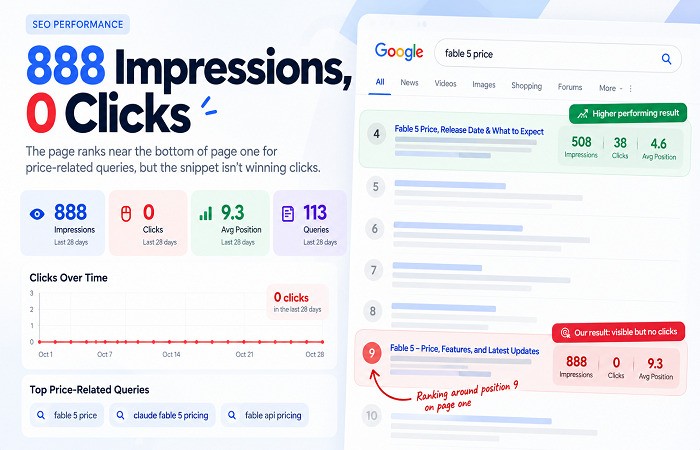
Over 28 days, one model page on OrcaRouter was shown 888 times and clicked zero times, at an average position of 9.3 [OURS: Search Console, 2026-09-24 to 2026-10-21]. The page is the one a fable 5 pricing search lands on, and the query set behind those impressions is unusually easy to read.
113 queries, one intent
The page ranks for 113 distinct queries. Fourteen of them account for 70 percent of the impressions, and all fourteen ask the same question:
| Query | Impressions | Position |
| claude fable 5 price | 152 | 8.4 |
| claude fable 5 pricing | 103 | 9.1 |
| claude fable pricing | 64 | 9.2 |
| fable 5 pricing | 57 | 10.9 |
| fable 5 price | 54 | 9.8 |
| fable api pricing | 35 | 7.4 |
| claude fable 5 api pricing | 33 | 8.0 |
| claude fable 5 api | 29 | 10.8 |
| claude fable price | 19 | 12.4 |
| fable 5 api pricing | 17 | 8.2 |
| fable api price | 16 | 8.9 |
| fable pricing | 16 | 9.7 |
| fable 5 api price | 15 | 7.5 |
| fable api | 15 | 7.5 |
Every one of those is a price query with a different word order. None of them asks what the model can do. That matters for how the page is written: a searcher who types “fable 5 price” wants a number in the first line of the snippet, and anything else on the page is a secondary detail they will only see after clicking.
What zero clicks at 9.3 actually means
Position 9.3 is the last slot of page one or the first of page two, depending on how Google lays the result out that day. The share of clicks available there is small — for a commercial query, low single digits on a good day.
Eight hundred eighty-eight impressions is about 32 a day. At a 1 percent click-through rate that would be roughly nine clicks over the month. At 0.2 percent, about two. Zero is at the low end of plausible rather than impossible.
Two readings fit, and they are not exclusive.
Reading one: the impressions include results nobody could click. If some of these queries render a price panel or an AI summary above the organic list, the page is counted as shown without ever being a candidate. The queries here — short, transactional, numeric — are exactly the kind that attract those treatments.
Reading two: the snippet does not answer the query. A page ranking ninth for “price” that shows a title about capability, or a meta description that starts with a release date, loses the click to whichever result shows a dollar figure. At position 9, the click is decided by the snippet, not the ranking.
The same site, a card that does convert
The contrast is one card over. OrcaCyber Zero 1.0 took 38 clicks from 508 impressions over the same window, at an average position of 4.6 [OURS]. That is a 7.5 percent click-through rate — roughly fifteen times what a position-9 page would expect.
Two differences explain it. The position is four and a half places better, and the winning queries are name queries rather than price queries: `orcacyber zero 1.0` at 103 impressions and position 2.4, `orcacyber zero` at 101 and 2.9. A name query has one obvious answer; a price query has several plausible ones and the searcher is scanning snippets for a number.
So the gap between the two cards is not only rank. It is also that one of them is the answer to its query and the other is a candidate for it.
What the page can control
Three levers, in order of how much they are worth here.
The title tag. A price query wants a price. A title that leads with the model name and the rate — not the tier, not the release month — puts a number into the snippet where a scanning searcher will see it.
The first paragraph. The snippet is often drawn from the opening text. If the opening sentence states the input and output rates, the description under the link does the work the position cannot.
Position, which is the slow one. Nine point three to a top-five placement is a whole page of ranking, and no snippet fixes that. What moves rank is the thing this batch of articles is for: links from pages that speak about this model, pointed at this card.
The zero is not a reason to rewrite; it is a reason to notice that the page is being shown for an intent it does not yet satisfy in the one line the searcher reads.
The takeaway
The Claude Fable 5 card earned 888 impressions, 0 clicks and an average position of 9.3 over 28 days, from 113 queries that are almost all one price question phrased in different word orders [OURS].
A page ranking ninth for a price query is not losing to better content. It is losing the snippet, and it is losing the position, and those are two different problems with two different fixes.
Sourcing note: all query, impression, click and position figures are from Search Console for the 28 days to 2026-10-21, page-level and page-by-query [OURS]. The comparison card’s figures come from the same export. The rates quoted in the recommendations — $10.00 input and $50.00 output per million — are read from the OrcaRouter public model card for `anthropic/claude-fable-5` on 2026-10-23 [OURS]. The interpretation of what a position-9 placement earns, and the reading of name queries against price queries, are our own. No competing gateway or inference marketplace is named. All values checked 2026-10-23.